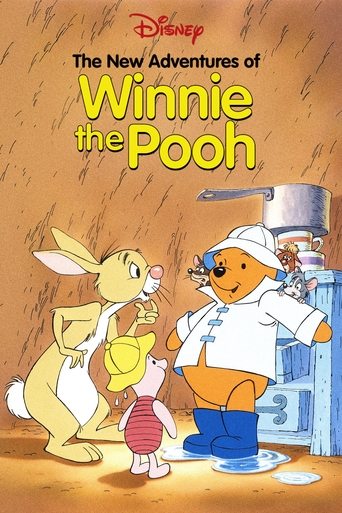
The New Adventures of Winnie the Pooh (1988)
การ์ตูนแอนิเมชันครอบครัวตลกเด็กแอนิเมชัน
- ประเทศ
- สหรัฐอเมริกา
- ปีที่ออกอากาศ
- 1988
- คะแนน
- 7.7/10
เรื่องย่อและรีวิว The New Adventures of Winnie the Pooh
The New Adventures of Winnie the Pooh เป็นการ์ตูนแอนิเมชัน ปี 1988
An American animated children's television series inspired by A. A. Milne's Winnie-the-Pooh stories.
เจาะลึก The New Adventures of Winnie the Pooh: เนื้อเรื่อง การสร้าง และเสียงวิจารณ์
The New Adventures of Winnie the Pooh is an American animated children's television series produced by Walt Disney Television Animation. Based on the Winnie-the-Pooh books by authors A. A. Milne and E. H. Shepard, The New Adventures was the first time a major Disney character headlined an animated, made-for-television series as well as the first Disney television series based on a major animated film. The cartoon premiered with a limited run on The Disney Channel on January 17, 1988. Nine months later, the show moved to ABC as part of their Saturday morning lineup. New episodes continued until October 26, 1991.
Proving popular with children and older fans, the series remained a staple on television in the United States for nearly two decades. Publications ranging from The Los Angeles Times to TV Guide gave it extremely positive reviews for its resemblance to the earlier Disney efforts and its high production quality, receiving praise for its wholesome tradition. The show won back-to-back Emmy Awards for Outstanding Animated Program as well as two Humanitas Prizes. The show was well received by both children and their parents. Most of the viewer mail the crew received were from parents thanking the staff for producing a show that they can watch with their children. The New Adventures is credited with bringing about a resurgence of Pooh animated media, including a series of television and video specials.
Premise
The series depicts the everyday lives of Christopher Robin and his 9 companions Pooh, Piglet, Tigger, Kanga, Roo, Rabbit, Eeyore, Owl and Gopher. Rather than a straightforward adaptation, the show was more Americanized than previous Pooh efforts. Episodes dealt with strong messages about honesty, responsibility, confidence, teamwork, friendship, and caring. Many stories are designed to help young children distinguish between fantasy and reality and overcome common childhood fears. Most episodes have two stories, but some are a single 22-minute episode.
Characters
Winnie the Pooh (voiced by Jim Cummings) is the main title character. He is a naive yet lovable and good-natured teddy bear. Cummings called the program timeless.
Tigger (voiced by Paul Winchell in seasons 1–3 and Jim Cummings in seasons 1–4) is an ebullient toy tiger. He is always filled with great energy and optimism, and though always well-meaning, Tigger can also be mischievous, and his actions have sometimes led to chaos and trouble for himself and his friends. Tigger is very confident and has quite an ego, having a high opinion of himself. Tigger has a notable habit of mispronouncing various words, or stressing wrong syllables in them. Unlike previous adaptations, Tigger is shown living in a large treehouse. Winchell thought of him as a cross between the Dead End Kids and the Cowardly Lion. He is one of the only members of the original cast involved.
Piglet (voiced by John Fiedler) is Pooh's best friend. He is a shy and kind-hearted toy piglet and is obsessed with keeping things neat and tidy, and enjoys beautiful things like flowers. His fears and nervousness often hinder his life, as Piglet runs and hides when unnecessary and often stutters when nervous, but has been shown to have a lot of hidden courage and often faces danger to help others. Piglet sometimes has an inferiority complex, although his friends think highly of him. Episodes about him tend to revolve around these traits as well as his small size. Fiedler is one of the only members of the original cast involved.
Eeyore (voiced by Peter Cullen) is a gloomy toy donkey. He is somewhat less caustic and sarcastic in this version than in the original stories. Despite his depressive nature, Eeyore is capable of great compassion. Eeyore usually expects misfortune to happen to him, such as his house of sticks to be knocked down regularly, but accepts it when it does.
Rabbit (voiced by Ken Sansom) is a sarcastic and finicky rabbit. In addition to wanting to be organized and practical, Rabbit's tendency to take charge is inflated to the extent that Rabbit becomes a control freak who insists on doing things exactly right, in his way and in the proper order. Rabbit keeps a garden and does whatever he can to protect it from other animals such as bugs and crows, often getting upset when anyone or anything tries to steal his vegetables. Rabbit and Tigger are usually foils for each other, reluctantly working together. Rabbit was shown as pale green in the series, compared to yellow in later efforts.
Kanga (voiced by Patricia Parris) is a toy kangaroo and Roo's mother. She rarely appears, but she is shown to be kindhearted and calm.
Roo (voiced by Nicholas Melody) is a young joey. He wears a light blue shirt. The smallest of the characters, Roo frequently is seen hanging around Tigger.
Gopher (voiced by Michael Gough) is a hard-working gopher who lives underground. Gopher is shown to be a bit of a workaholic, and is obsessed with dynamite and digging in his tunnels. Gopher speaks with a Southern accent, whistles his "Ss" and wears a helmet with a light attached.
Owl (voiced by Hal Smith) is the eldest character in the series. He presents himself as a mentor and teacher to the others, but is really quite scatterbrained. Owl enjoys telling stories about his distant relatives whenever a certain event reminds him of one, but many of his stories are pointless or absurd. Owl speaks with a Southern English accent. Along with Fielder, Smith was one of only two members of the original cast involved in the show for its entire run.
Christopher Robin (voiced by Tim Hoskins) is a young boy that has adventures with the stuffed animals. He's also Pooh's other best friend.
For the most part, the show used a limited cast consisting only of characters in the original Milne books, with the notable exception of the Disney-created character Gopher. However, several minor characters did make appearances. Christopher Robin's mother is shown occasionally, but always with her face obscured.
Kessie, a female bluebird that Rabbit rescues, makes her first appearance in this series; Kessie would later appear in The Book of Pooh. Stan Woozle and Heff Heffalump appear as a pair of honey-stealing thieves. This marked the first time heffalumps and woozles were seen on-screen. Prior to this, heffalumps and woozles had always been portrayed as creatures that did not exist and were representative of childhood fears. Instead, the show used other unseen villains such as Jagulars and the "Grab-Me Gotcha." Papa Heffalump also appeared from time to time. Other characters on the show include Owl's cousin Dexter (voiced by Hal Smith) and Skippy the Sheepdog. Chuck McCann provided additional voices as well.
Origin
Winnie the Pooh was created by British authors A. A. Milne and E. H. Shepard in the 1920s. The character was named after a teddy bear owned by Milne's son, Christopher Robin Milne. He had named his toy bear after Winnie, a Canadian black bear he often saw at London Zoo, and "Pooh", a swan they had met while on holiday. Drawing from this and other toys owned by his son, Milne created the world of Winnie-the-Pooh. He first appeared by name on December 24, 1925, in a Christmas story commissioned and published by the London Evening News. The following year, a collection of Pooh stories was formally released bearing the name Winnie-the-Pooh. The stories proved very popular and inspired a sequel.
The idea for a television series was first discussed in 1957. NBC suggested Jay Ward undertake the pilot, then titled The World of Winnie the Pooh, with an option for thirty-nine episodes. Some songs and bits of dialogue were recorded, but the project was ultimately abandoned. In 1961, Disney's namesake founder Walt Disney purchased the film rights to make an animated movie starring the characters. He subsequently produced a series of three short featurettes throughout the late 1960s and early 1970s, beginning with Winnie the Pooh and the Honey Tree (1966). Disney had also aired a variety show with the characters that used electronically controlled puppetry and life-sized costume titled Welcome to Pooh Corner. This became the highest rated program on The Disney Channel. The original featurettes also proved popular, with video sales topping the charts in 1986 and 1987.
Development
An animated cartoon starring the characters was first proposed by Walt Disney Television Animation Vice President Gary Krisel during a Disney retreat, in which company assets and future prospects were examined. Rich Frank later recalled him saying: "I think Pooh is a great character for Saturday morning animation". He believed the merchandising license, held at that time by Sears, would work as a great promotional tool. Mark Zaslove was contacted to write the series bible; he had recently finished work on the DuckTales pilot episode. The document was written over Memorial Day weekend 1987, with Zaslove having only three days to complete the proposal. The pitch was well received by Disney and subsequently green-lit.
Instead of shopping Winnie the Pooh around to different networks, the show was pitched directly to ABC. The network had desperately wanted a cartoon from Disney for their Saturday morning schedule, which had fallen to last place in the ratings. They had hoped Pooh could boost ratings for the channel, specifically that they believed Winnie-the-Pooh would draw an audience old enough to operate the people meter that largely dictated television ratings at the time; ABC had blamed the people meter being too difficult for young children to operate for the failure of its previous series The Little Clowns of Happytown, a show geared toward a preschool-aged audience. Two years earlier, Michael Eisner and Krisel had set up meetings with all three major networks in hopes to sell rights to their two cartoon series: Disney's Wuzzles and Adventures of the Gummi Bears. CBS and NBC had purchased Wuzzles and Gummi Bears respectively. Realizing they had nothing left to offer ABC, Eisner and Krisel met with them anyway and received a warm response to the gaffe. A deal was reached giving ABC the show, while giving first run rights to The Disney Channel.
The show was official announced via a press release on November 15, 1987. It would mark the first time a prominent Disney character was seen on Saturday morning television. The series was viewed as a gamble, with people unsure if Pooh would survive on the new medium. Because Saturday morning cartoons had a reputation for dry and repetitive storylines, shallow characters, clichéd narratives, and cheap animation, animation fans greeted Disney's plans to adapt the books to the small screen with a mixture of skepticism and dismay, fearing the show could not top the original featurettes.
Production
ABC eagerly commissioned 25 half-hour episodes of The New Adventures of Winnie the Pooh for its first season, rather than the standard 13 to 17. Karl Geurs, a self-described Pooh fan, developed the series, which took several months. At the time, Walt Disney Television Animation had only 80 employees and two projects in production. The department did not yet have in-house facilities built, so employees worked out of the Academy of Television Arts & Sciences building. Disney put the same high standards of expectation that they had with their feature films. They had hoped to set a new standard of excellence in Saturday morning television, one with "storytelling rich in language and values, as well as delightful well acted characters" that would appeal to audiences of all ages.
The writing process began with story premises being pitched to Zaslove, who served as story editor for the first season. The best ones were selected and sent to ABC executives for approval, followed by story outlines and scripts. The process took around four weeks per episode. The crew were "dyed-in-the-wool" fan of Milne's works, constantly checking their work against published Pooh books in order to stay true to the original sense of Milne. Special attention was given to maintain the personalities of the characters as they had originally been written. The cartoon attempted to have the right balance of both action-adventure sequences and moments of whimsy. The staff often found trouble working with the limited cast, with supervising director Ken Kessel quoted as saying: "You are restrained by what the characters can do and who they are". The writing staff hoped to channel the spirit of the Walt Disney shorts of the 1940s, drawing inspiration from artists Jack Hannah, Ward Kimball, and Jack and Dick Kinney.
The series had one internal standards director. Care was made to ensure there was no imitable behavior that children could copy. A source of friction on the show was whether Gopher was allowed to have gunpowder. A consulting company based in Glendale, California advised the team on how the characters should speak, look, and act in order to better appeal to the target demographic. The relationship with the production staff was described as positive.
Like most other cartoons, the animation was outsourced to other countries. This was mainly done for cost purposes and the limited availability of artists in the United States. All the writing, music, direction, character design, and color was worked by around 30 Disney employees in Hollywood. After this, everything was sent overseas for the animation. Approximately 300 employees would work on inking and printing. An unusually high number of animation cels were used for the show, with 20,000 cels in each episode as opposed to 8,000–12,000 for typical cartoons. The show had more drawings per minute than any other television cartoon at the time. Early episodes were completed by TMS Entertainment in Tokyo, Japan and later by Walt Disney Animation UK Ltd. in London, England, Hanho Heung-Up in Seoul, South Korea and Wang Film Productions in Taipei, Taiwan. Sixteen episodes were also produced by Walt Disney Television Australia in Sydney, New South Wales. The show set a benchmark for similar cartoons that both Disney as well as other channels expected for future shows.
After the animation was completed, the production reels were sent back to the United States where music and sound effects were added. The show's theme song, entitled "Pooh Bear", was written by Steve Nelson and sung by Steve Wood. A version with Nelson doing the vocals later appeared on his Listen What the Katmandu album. Another version of the song with Jim Cummings doing the vocals (who also voiced Pooh and Tigger) appeared in reruns of the series on The Disney Channel in 1994. Nelson also composed several additional songs that were shown on the early episodes. The music was particularly praised by critics. The show's underscore was composed by Thom Sharp. An orchestra was used to record the music, using instruments such as trumpets, woodwinds, and a full string section. The composers were given the unique opportunity to examine the animator's exposure sheets, enabling them to write music while an episode was being scripted.
Casting
The producers actively sought out the surviving original voice cast who had been used in the 1960s featurettes. Sterling Holloway, the original voice of Winnie the Pooh, read for the part, but although he was still able to perform the voice as he had, producers concluded that Holloway likely could not handle the strain of a full series commitment at his age, a decision that angered Holloway's agent. A casting call was held and Jim Cummings was selected as his replacement, a role he has continued with to the present day. Cummings has claimed that veteran actors such as Burgess Meredith and E. G. Marshall had read for the part of Pooh as well.
Paul Winchell, John Fiedler and Hal Smith, the original voices for Tigger, Piglet, and Owl respectively, returned for the series. On advice from his cardiologist, Winchell mostly avoided recording with the rest of the cast to avoid the stress so the studio allowed him do his voices alone. Meanwhile, Winchell was making various trips to Africa to cure hunger, in which Cummings often understudied for Winchell. Throughout the series, Winchell voiced Tigger in the first two seasons and select episodes of the third season before Cummings took over the role. When Cummings took over, Winchell said: "Take care of my little friend for me."
Most of the recording sessions occurred at B&B Sound in Burbank, California. Advanced technology allowed for the actors to record their roles without having to be in the same room. For example, Fiedler recorded his role from New York while Winchell recorded some from Florida. Cummings described Fielder's voice as "kind of like the wind blowing through tall grass. It sounded homey, and it sounding comforting." Fiedler stated he was very proud of his work on the show having enjoyed the role as much as when he started in 1968. Ken Sansom was cast as Rabbit, he later described voicing Rabbit in the series as the best professional experience he ever had.
Promotion
Going into the 1988–89 television season, networks had been struggling with a drop in ratings among children. ABC itself experienced a decline of 37 percent in kids under the age of 6. It had been surmised by ABC executives that this was due to a change in the way Nielsen ratings were collected. The data had historically been recorded automatically by a device inside household television sets. However, this had been changed the year before; children now had to use people meters for their viewership to be counted. This required manually pushing buttons that would clock kids in and out of programs, something they often had trouble successfully completing. What resulted was a demographic that could not be guaranteed to advertisers.
In order to combat this, ABC decided to fill their programming with "old favorites". The studio began to develop and retool preexisting characters and shows, ones that they hoped could attract older children and their parents into watching the program. Winnie the Pooh became the centerpiece in this plan, with the show was described as the highlight of ABC's Saturday morning schedule. The character had what network executives call "marquee value"—meaning they are familiar and already have a built-in audience. Squire Rushnell, Children's Vice President for ABC, was hoping Pooh could draw a "somewhat more sophisticated" audience in the range from 6 to 11 years.
In the three weeks leading up to its debut, ABC began airing promotions for the cartoon during prime-time hours. This was seen as a very unusual occurrence. Part of the reason this was done was to fill airtime, as the 1988 Writers Guild of America strike had caused production to be halted on prime-time television shows. Advertisements for The New Adventures of Winnie the Pooh were played during adult-oriented shows such as Thirtysomething and Moonlighting using the tagline "Now you can share your childhood heroes with your children". A television commercial that aired during the ABC Sunday Night Movie on September 4, 1988, used the tagline "Before taxes. Before puberty. There was childhood. And Winnie the Pooh".
The evening before the show made its broadcast debut, ABC aired a thirty-minute Saturday morning preview show featuring Winnie the Pooh and characters from two other debuting cartoons, The New Adventures of Beany and Cecil and A Pup Named Scooby-Doo. The show placed second in its time slot with a 7.3 rating and a 14 share, with 11.2 million viewers watching.
Sears & Roebuck and Honey Nut Cheerios partnered to host a nationwide premiere party to celebrate the series coming to ABC. Over 300 Sears stores across the country participated in the breakfast, which doubled as a charity event. The first episode was telecast on in-store video displays. More than 40,000 children attended the event. Some stores had Winnie the Pooh characters show up in costume. Sears also dedicated eight pages of their Christmas catalog to the series.
Broadcast history
During the late 1980s, a debate emerged inside Disney about whether original programs should be aired on The Disney Channel or outsourced to other networks. Some executives felt that The Disney Channel was essential to the company's growth. Others such as Gary Krisel disagreed, believing it would risk losing a generation of TV viewers who did not have cable. In the end, a compromise was reached with Disney Channel President John F. Cooke, who agreed to "pay" Krisel's division a certain price if he could get first-run rights. The show premiered on The Disney Channel on January 17, 1988. Thirteen episodes aired at 8:30am on weekends. The show's run ended that July.
The show then moved to Saturday morning on ABC where it aired for a full hour from 8:30am to 9:30am. For the second season, the show was cut back to 30 minutes to make room for new entries. The show was merged with Disney's Adventures of the Gummi Bears and aired as part of the Gummi Bears-Winnie the Pooh Hour. This partnership was short-lived and lasted only one year, when Gummi Bears moved to The Disney Afternoon. Winnie the Pooh returned as a solo effort the following year. New episodes intermixed with reruns returned for a third season in the fall of 1990. During this time, two of the show's characters—Winnie the Pooh and Tigger—were incorporated into the television special Cartoon All Stars to the Rescue. The show returned for a fourth season on September 7, 1991. The show was not renewed the following year. After the series ended, the crew produced Winnie the Pooh and Christmas Too, a primetime spin-off of the show.
Despite production ending the year before, reruns of the show continued on ABC's fall schedule for the 1992–93 season. By the following year, the show was dropped altogether by ABC and sold in syndication. Executives felt the show could make more money selling directly to television stations rather than accepting ABC's license fee. The show returned on ABC in late 1995 when reruns of the program replaced The New Adventures of Madeline. It returned again to the ABC lineup on January 4, 1997, as part of Disney's purchase of ABC the year prior; these reruns continued until September 7, 2002.
The Disney Channel began airing reruns of the series on October 3, 1994, in the United States. The show also began airing in the channel's preschool block, Playhouse Disney, when the block launched on February 1, 1999. These continued until September 1, 2006, at which point it was taken off the channel's schedule. Playhouse Disney on the other hand ran it until August 1, 2006, one month before Disney Channel ended its run. It was also shown on Toon Disney, first airing on April 18, 1998, and ran until October 19, 2007. Internationally, the show has aired in several countries including Seven Network (later The Disney Channel) in Australia, CITV (later The Disney Channel) in the United Kingdom, TF1 in France, Super RTL in Germany, Rai 1 and Rai 2 in Italy, TV Tokyo (later Disney Channel, Tokyo MX, Toon Disney, Disney XD, Disney Junior, and NHK BS Premium) in Japan, SBT (later Disney Weekend, Disney Channel and Claro TV's channel) in Brazil, and Family Channel in Canada, India, and Poland.
เนื้อหาส่วนนี้มาจากบทความ “The New Adventures of Winnie the Pooh” ในวิกิพีเดีย (en.wikipedia.org) เผยแพร่ภายใต้สัญญาอนุญาตครีเอทีฟคอมมอนส์ แสดงที่มา-อนุญาตแบบเดียวกัน 4.0 (creativecommons.org/licenses/by-sa/4.0) มีการตัดส่วนอ้างอิงและจัดรูปแบบใหม่
การ์ตูนแอนิเมชันเรื่องอื่นที่น่าสนใจ
Doozie’s Doghouse (2026)

Clara and the Below (2026)

The Eyes (2026)
Bass X Machina (2026)
TED: The Animated Series (2026)

Tomfoolers (2026)
 EP13★ 8.7
Avatar: Seven Havens (2026)
Super Why’s Comic Book Adventures (2026)
 EP6
GET JIRO (2026)
 ★ 7.9
LEGO ONE PIECE เลโก้ วันพีซ (2026)
Bandbudh aur Budbak 2.0 (2026)
 ★ 7.9