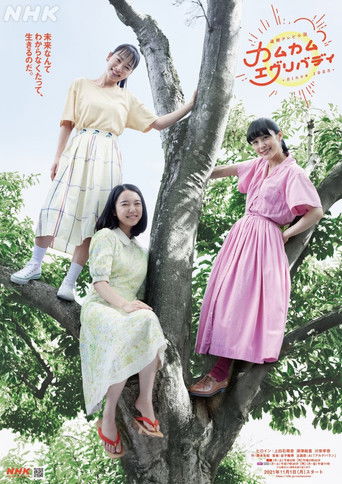
Come Come Everybody (2021)
ซีรี่ย์ญี่ปุ่นครอบครัวดราม่าตลก
- ชื่อภาษาอังกฤษ
- Come Come Everybody
- ประเทศ
- ญี่ปุ่น
- ปีที่ออกอากาศ
- 2021
เรื่องย่อและรีวิว Come Come Everybody
Come Come Everybody เป็นซีรี่ย์ญี่ปุ่น ปี 2021
ยังไม่มีเรื่องย่อภาษาไทย แสดงเรื่องย่อต้นฉบับภาษาอังกฤษ
Come Come Everybody is a Japanese television drama series and the 105th NHK Asadora series, following Okaeri Mone.. It depicts the lives of three generations of women who have close links to the English lessons on radio which began in 1925.
เจาะลึก Come Come Everybody: เนื้อเรื่อง การสร้าง และเสียงวิจารณ์
Come Come Everybody (Japanese: カムカムエヴリバディ, Hepburn: Kamu Kamu Evuribadi) is a Japanese television drama series and the 105th NHK Asadora series, following Welcome Home, Monet. It premiered on November 1, 2021, and concluded on April 8, 2022. The story is about three generations of a family, Yasuko (grandmother), Rui (mother), and Hinata (daughter) who worked with a radio English course during the Shōwa, Heisei, and Reiwa eras. The drama is set in Okayama, Osaka and Kyoto.
Plot
The story is about a three generations of a family, Yasuko (grandmother), Rui (mother) and Hinata (daughter) who worked with a radio English course during the Shōwa, Heisei, and Reiwa eras. While facing the challenges of the Shōwa, Heisei, and Reiwa eras, the three find their own way of life in love, work, and marriage. The story unfolds in a heroine relay system.
Yasuko Tachibana was born in Okayama City in 1925, the year radio broadcasts began in Japan. Yasuko grows up in a warm family who owns a Japanese sweets shop in the shopping district of Okayama city. Her family wishes for her to inherit the shop but the war changed her fate. Her story is Japanese sweets and baseball-themed.
Yasuko's daughter, Rui's story begins in Osaka in 1955 with jazz as its theme. Rui separates from her mother for some reason and opens the way to live under her own will and power, even though she is hurt and lost. Rui hates her mother and English.
Meanwhile the story of Hinata, Rui's daughter and Yasuko's granddaughter, sets off in Kyoto in 1965 as a historical drama. Unlike her grandmother, Hinata was born in a peaceful time, and is a sweetheart. Hinata is a little useless but she plays an important role in this three-generation family story.
Heroines
Mone Kamishiraishi as Yasuko Tachibana / Yasuko Kijima
Ibuki Amimoto as young Yasuko
Ryoko Moriyama as old Yasuko, also known as Annie Hirakawa
Eri Fukatsu as Rui Kijima, Yasuko's daughter
Misaki Nakano as young Rui (from age three to five)
Rin Furukawa as young Rui (age seven)
Rina Kawaei as Hinata Otsuki, Rui's daughter and Yasuko's granddaughter
Chise Niitsu as young Hinata
Tachibana Family
Masahiro Kōmoto as Kinta Tachibana, Yasuko's father
Naomi Nishida as Koshizu Tachibana, Yasuko's mother
Gaku Hamada as Santa Tachibana, Yasuko's older brother
Shinya Owada as Kinetarō Tachibana, Yasuko's grandfather
Machiko Washio as Hisa Tachibana, Yasuko's grandmother
Kijima Family
Yasunori Danta as Senkichi Kijima
YOU as Midori Kijima, Senkichi's wife
Hokuto Matsumura as Minoru Kijima, Senkichi's elder son / Yasuko's husband
Nijiro Murakami as Isamu Kijima, Senkichi's younger son / Yasuko's friend
Yūki Meguro as old Isamu Kijima
Yui Okada as Yukie, Kijima family's helper
Yumi Takigawa as old Yukie
Kanoko Nishikawa as Tami Murano, Kijima family's helper
People from Shopping Street
Karin Ono as Kinu Mizuta, Yasuko's friend
Goe Asagoe as Uhei Mizuta, the owner of Mizutaya tofu shop
Megumi Komaki as Hanako Mizuta, Uhei's wife
Keisuke Horibe as Kichibee Akanishi, the owner of Akanishi hardware shop, and adult Kichiemon.
Mai Miyajima as Kiyoko Akanishi, Kichibee's wife
Chieko Matsubara as old Kiyoko
Seiichiro Nakagawa as Kichiemon Akanishi, Kichibee's son
Yūki Tokunaga as Kichinojō Akanishi, Kichibee's grandson
Masanori Sera as Teiichi Yanagisawa, the owner of Dippermouth Blues cafe
Tomoya Maeno as Kenichi Yanagisawa, Teiichi's son
Oideyasu Oda as Shinpei Morioka
Others from Okayama
Masashi Sada as Tadaichi Hirakawa, an English radio lecturer
Tatsumasa Murasame as Robert Rosewood, an Expeditionary Army Officer / American man who loves Yasuko
Mahiru Konno as Sumiko Ogawa, a housewife
Yuu Tokui as Kowamote no Tanaka, a debt collector
Midori Wakai as Ogura Kuma, a Minoru's Boarding House landlord
Sō Takei as Kanda Takeshi, an imperial soldier
People in Osaka
Joe Odagiri as Joichiro "Joe" Otsuki, Rui's husband
Mikako Ichikawa as Ichiko "Berry" Noda, a female customer at Jazz cafe
Tōko Miura as Ichie Noda, Ichiko's daughter
Taichi Saotome as Kitazawa ”Tommy” Tomio, a musician
Takehiro Murata as Heisuke Takemura, the owner of Takemura Cleaning Shop
Mari Hamada as Kazuko Takemura, Heisuke's wife
Yoshimasa Kondo as Yosuke Kogure, a bartender and owner of Jazz cafe
Shohei Shofukutei as Futoshi Nishiyama
Others
Onoe Kikunosuke V as Kennosuke Momoyama I, a movie star, and Kennosuke Momoyama II
Kanata Hongō as Bunshirō Igarashi
Yua Shinkawa as Sayoko Fujii, Hinata's friend
Production
This is the first time in the history of a serial television novel that three actresses play the three main characters as different heroines. The heroine baton will be passed down to the next generation in a relay system.
The title Come Come Everybody is the title of the opening song of the NHK Radio English course, commonly known as "kamu kamu eigo" by Tadaichi Hirakawa, that once dominated Japan immediately after the end of the war. When the lyrics "Come come everybody" and the melody of the Japanese children's song "Shojoji no Tanukibayashi" started, children and elderly people all over Japan were hooked and encouraged by the cheerful voice. It conveyed Hirakawa's desire to "brighten" the dark postwar Japan. The title was made with the wish that the slogan "Come Come Everybody" would be a power word to open up the future to live in the present.
Mone Kamishiraishi and Rina Kawaei were selected as heroines through an audition which received 3061 applicants. Eri Fukatsu was chosen by NHK. This is Mone Kamishiraishi and Eri Fukatsu's first appearance in an asadora. Rina Kawaei already appeared in the asadora Toto Neechan (2016).
On July 21, 2021, it was announced that the broadcast would start on November 1, 2021. On September 27, it was announced that the theme song for Come Come Everybody would be "Aldebaran", a song recorded by Japanese-American singer-songwriter Ai that was released on November 1, 2021. The song, written Naotarō Moriyama features arrangements by Neko Saito and was produced by Ai and Saito. The song originally was about environmental issues and was titled "Daphnia Pulex". "Aldebaran" was not intended to be the theme song for Come Come Everybody until Moriyama allowed Ai to record the song with reworked lyrics. "Aldebaran" was later included on Dream, Ai's twelfth studio album.
On October 7, 2021, the main poster of the drama was released. The poster photo was taken by photographer Takehide Niitsubo. The theme of the three heroines is "Family Tree", and it is expressed through an image of a family photo that transcends three generations of parents and children.
เนื้อหาส่วนนี้มาจากบทความ “Come Come Everybody” ในวิกิพีเดีย (en.wikipedia.org) เผยแพร่ภายใต้สัญญาอนุญาตครีเอทีฟคอมมอนส์ แสดงที่มา-อนุญาตแบบเดียวกัน 4.0 (creativecommons.org/licenses/by-sa/4.0) มีการตัดส่วนอ้างอิงและจัดรูปแบบใหม่
ซีรี่ย์ญี่ปุ่นเรื่องอื่นที่น่าสนใจ

It's Strictly Business It’s Strictly Business (2026)
Devils' Crest Devils’ Crest (2026)
Did Someone Happen to Mention Me? (2026)

あにいもうと (2026)

SQUALL (2026)
この味もまたいつか恋しくなる (2026)

Quiztopia (2026)

LOST10 (2026)

Extraordinary Attorney Minami (2026)
ユージニア (2026)

真田十勇士 SHADOWS OF THE TEN NINJA (2026)